You’ve heard the buzz about 5G revolutionizing mobile connectivity, but what does it actually mean? This mobile networks guide breaks down how 5G works in simple terms, cutting through the technical jargon to explain what makes this technology different and why it matters for your everyday life.
What Exactly Is 5G?
5G stands for “fifth generation” wireless technology. Just as 4G replaced 3G and brought us faster mobile internet, 5G represents the next evolutionary step in how our devices connect to networks.
Think of mobile network generations like highway systems. 3G was a two-lane road, 4G expanded it to four lanes, and 5G builds a multi-level superhighway with dedicated express lanes. This mobile networks guide will help you understand why that matters.
The Basic Building Blocks of How 5G Works
Radio Waves Carry Your Data
At its core, 5G explained simply means understanding that all wireless communication relies on radio waves traveling through the air. Your phone sends and receives data by converting information into radio signals that bounce between your device and cell towers.
What makes 5G different is which radio waves it uses and how efficiently it transmits information on those waves.
Frequency Bands: The Roads Data Travels
When learning how 5G works, frequency bands are crucial to understand. Radio waves exist across a spectrum of frequencies, measured in hertz. Different frequencies behave differently:
Low-band frequencies (below 1 GHz) travel far and penetrate buildings well but carry less data. Think of these as slow-moving trucks that can travel long distances.
Mid-band frequencies (1-6 GHz) balance range and speed. These are like standard highway traffic—decent speed with reasonable coverage.
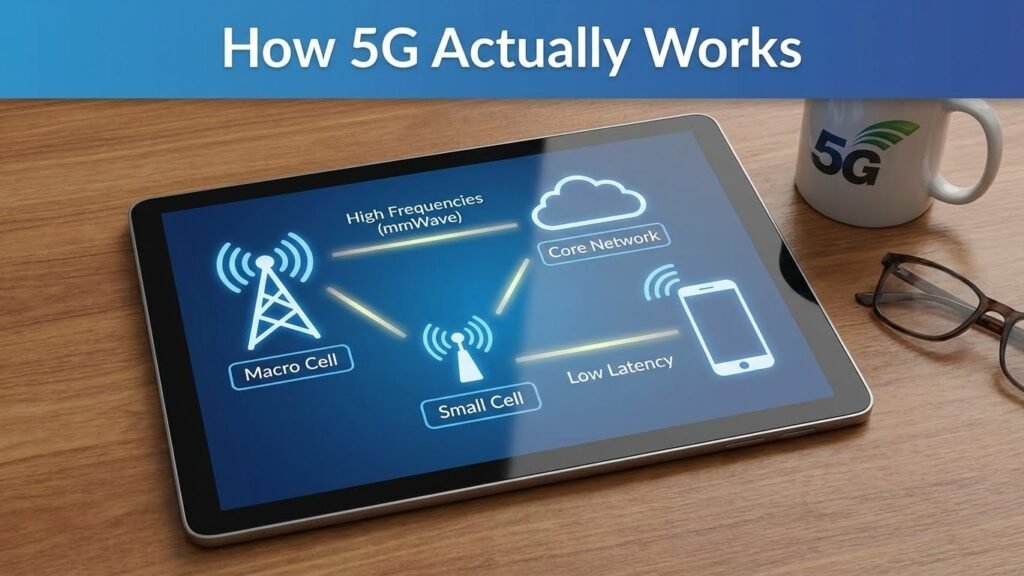
High-band frequencies (24-100 GHz, called millimeter wave or mmWave) carry massive amounts of data but barely penetrate walls and only travel short distances. These are like ultra-fast delivery drones that work great in small areas.
How 5G Networks Are Structured
Small Cells Replace Giant Towers
Traditional cellular networks relied on tall towers covering wide areas. This mobile networks guide emphasizes that 5G works differently, especially with high-band frequencies.
Because mmWave signals don’t travel far, 5G networks deploy many small cell sites—compact equipment mounted on light poles, building sides, or dedicated small towers. These small cells create a dense network of overlapping coverage areas.
In urban environments where 5G explained means ultra-fast speeds, you might have a small cell every few hundred feet. This density is essential for how 5G works at its highest performance levels.
Network Slicing: Customized Connections
One innovative aspect of how 5G works is network slicing. Imagine dividing a physical highway into virtual lanes dedicated to different purposes—one for emergency vehicles, one for deliveries, one for commuters.
Network slicing allows 5G networks to create multiple virtual networks on the same physical infrastructure. Your video stream gets one slice with appropriate speed and latency, while a self-driving car gets a dedicated slice guaranteeing ultra-reliable, low-latency communication.
Key Technologies That Make 5G Work
Massive MIMO: Multiple Antennas Working Together
MIMO stands for Multiple Input Multiple Output. If 4G towers had a handful of antennas, 5G towers have dozens or even hundreds working simultaneously.
Think of it like going from a single checkout lane at a store to having 50 lanes open. More antennas mean more devices can communicate at once without waiting, and the network can direct signals precisely where they’re needed rather than broadcasting in all directions.
This technology is fundamental to how 5G works efficiently in crowded areas like stadiums or city centers.
Beamforming: Focused Signal Delivery
Instead of broadcasting signals equally in all directions like a lightbulb, beamforming allows 5G towers to focus signals directly at your device like a spotlight following an actor on stage.
This mobile networks guide highlights beamforming as critical because it reduces interference, extends range, and improves efficiency. The network actively tracks your device and adjusts the beam direction as you move.
Advanced Modulation: Packing More Data
5G explained in technical terms involves advanced modulation schemes that pack more data into each radio wave. It’s like upgrading from sending one letter at a time to sending entire books.
By encoding information more efficiently, 5G transmits significantly more data using the same amount of radio spectrum compared to 4G.
The Three Types of 5G Deployment
Low-Band 5G: Wide Coverage, Modest Speed Gains
Many carriers initially deployed 5G on low-band frequencies because these provide nationwide coverage without requiring massive infrastructure investment.
Low-band 5G works similarly to 4G in terms of coverage area but offers improved capacity and slightly faster speeds. This is often what your phone connects to when showing a 5G icon in suburban or rural areas.
Mid-Band 5G: The Balanced Approach
Mid-band spectrum offers the best balance in this mobile networks guide. It provides substantially faster speeds than 4G while covering larger areas than high-band 5G.
Countries allocating significant mid-band spectrum have seen the most impressive 5G performance gains. This is how 5G works for most people in most places—noticeably faster than 4G without requiring you to stand next to a small cell.
High-Band mmWave 5G: Maximum Speed, Minimum Range
Millimeter wave 5G delivers mind-blowing speeds—potentially gigabits per second, fast enough to download a full movie in seconds. However, these signals barely penetrate glass, can be blocked by leaves, and only work within a few hundred feet of a small cell.
High-band 5G works best in dense urban areas, stadiums, airports, and shopping centers where many people need extremely fast connectivity in a small space.
How 5G Handles Devices and Traffic
Dynamic Spectrum Sharing
Early 5G deployments faced a challenge: networks needed to support both 4G and 5G devices simultaneously on the same frequencies. Dynamic Spectrum Sharing allows towers to allocate spectrum in real-time between 4G and 5G based on demand.
This technology is essential for how 5G works during the transition period when not everyone has upgraded their devices. The network intelligently manages resources, giving each generation what it needs at any moment.
Edge Computing: Processing Data Closer to You
Part of how 5G works involves moving data processing from distant data centers to local edge servers near cell towers. This reduces the time it takes for data to travel back and forth, creating ultra-low latency.
When this mobile networks guide mentions latency, it means the delay between requesting information and receiving it. 5G aims for latency as low as 1 millisecond, compared to 30-50 milliseconds on 4G.
Edge computing makes applications like remote surgery, autonomous vehicles, and responsive virtual reality possible by processing critical data locally rather than sending it across the country.
Real-World Applications of How 5G Works
Enhanced Mobile Broadband
The most immediate benefit of 5G explained simply is faster mobile internet. Streaming 4K video without buffering, downloading large files instantly, and enjoying lag-free video calls become standard experiences.
For home internet, 5G wireless broadband offers an alternative to cable or fiber, particularly in areas where traditional wired infrastructure is expensive or unavailable.
Internet of Things at Scale
How 5G works for IoT devices differs from consumer smartphones. The technology supports massive numbers of connected sensors and devices—smart city infrastructure, industrial monitoring, agricultural sensors—without overwhelming the network.
Special 5G IoT protocols optimize for devices that send small amounts of data infrequently while maximizing battery life. A sensor might run for years on a single battery while staying connected to the 5G network.
Mission-Critical Communications
Network slicing and ultra-low latency enable applications where reliability is paramount. Emergency services, remote medical procedures, and industrial automation require networks that respond instantly and never fail.
This mobile networks guide emphasizes that 5G works for these scenarios through guaranteed bandwidth allocation and redundant connections that automatically reroute if problems occur.
Understanding 5G Coverage and Performance
Why 5G Speed Varies So Much
If you’ve tested 5G and found speeds anywhere from barely faster than 4G to hundreds of megabits per second, you’re experiencing how 5G works across different frequency bands and coverage areas.
Your actual experience depends on which type of 5G you’re connected to, how many other people are using the same cell, your distance from the tower, and obstacles between you and the antenna.
Building Out 5G Networks Takes Time
Creating comprehensive 5G coverage requires significant investment. Carriers must install new equipment on existing towers, deploy thousands of small cells in cities, and acquire rights to optimal frequency spectrum.
This mobile networks guide acknowledges that true 5G with transformative speed improvements will roll out gradually over years, not months. Current 5G coverage represents early stages of a long-term infrastructure project.
Common Misconceptions About How 5G Works
5G and Health Concerns
Despite persistent myths, scientific research has not found evidence that 5G radio waves harm human health. 5G explained from a safety perspective uses non-ionizing radiation, similar to radio and television broadcasts that have existed for decades.
The frequencies and power levels fall well within international safety guidelines. Organizations like the World Health Organization continue monitoring research but currently indicate no known health risks from 5G exposure.
5G Doesn’t Cause Weather Problems
Some early 5G deployments near weather satellite frequencies raised concerns about potential interference with meteorological data collection. Regulatory coordination addressed these issues by establishing appropriate frequency guardrails.
Understanding how 5G works includes recognizing that proper spectrum management prevents conflicts between different wireless services.
The Future Beyond 5G
While 5G networks continue expanding, researchers are already exploring 6G technologies. This mobile networks guide looks ahead to networks operating at even higher frequencies with artificial intelligence integrated directly into network infrastructure.
The evolution from 4G to 5G demonstrates how wireless technology advances through combining multiple innovations rather than single breakthroughs. Each generation builds on lessons learned from previous networks while introducing new capabilities.
Making Sense of 5G for Your Life
How 5G works might seem complex, but the practical impact is straightforward: faster speeds, more reliable connections, and support for innovative applications that weren’t possible before.
Whether 5G explained means understanding technical details or simply knowing what to expect from your next phone upgrade, the technology represents a meaningful step forward in mobile connectivity. As networks mature and coverage expands, the benefits of 5G will become increasingly apparent in everyday digital experiences.
The transition to 5G isn’t about making phone calls differently—it’s about enabling entirely new ways of using wireless connectivity that will shape technology for the next decade.
Have questions about how 5G works in your area? Share your 5G experiences or questions in the comments below.